Orthopedic Cable System for Patella Fracture FixationOrthopedic Cable System for Patella Fracture Fixation: Principles, Classification, and Surgical Techniques
Orthopedic Cable System in Modern Orthopedic Surgery
Patella fractures are among the most common injuries affecting the knee extensor mechanism. Stable fixation is essential for restoring knee function, enabling early mobilization, and reducing postoperative complications. In recent years, the orthopedic cable system has become an important solution in orthopedic trauma surgery due to its high strength, excellent flexibility, and reliable fixation performance. An orthopedic cable is commonly manufactured from multi-strand medical-grade stainless steel or titanium alloy materials. Compared with traditional fixation wires, modern orthopedic cable systems provide improved fatigue resistance, better compression force distribution, and enhanced biomechanical stability.

Orthopedic cable fixation systems are widely used in:
Patella fracture fixation
Olecranon fracture fixation
Greater trochanter fixation
Periprosthetic fracture stabilization
Cerclage fixation in trauma and revision surgery
Complex comminuted fracture reconstruction
With advances in minimally invasive orthopedic techniques, orthopedic cable systems are increasingly preferred by orthopedic surgeons worldwide.
Anatomy and Biomechanics of the Patella
The patella is the largest sesamoid bone in the human body and plays a critical role in the knee extensor mechanism. It improves quadriceps leverage and transmits tensile forces generated during knee extension.
Because the patella is exposed to substantial tensile stress during movement, fracture fixation must withstand significant biomechanical loads. Inadequate fixation may result in:
The use of an orthopedic cable system helps convert tensile forces into compressive forces at the fracture site, promoting stable fixation and bone healing.

Classification of Patella Fractures
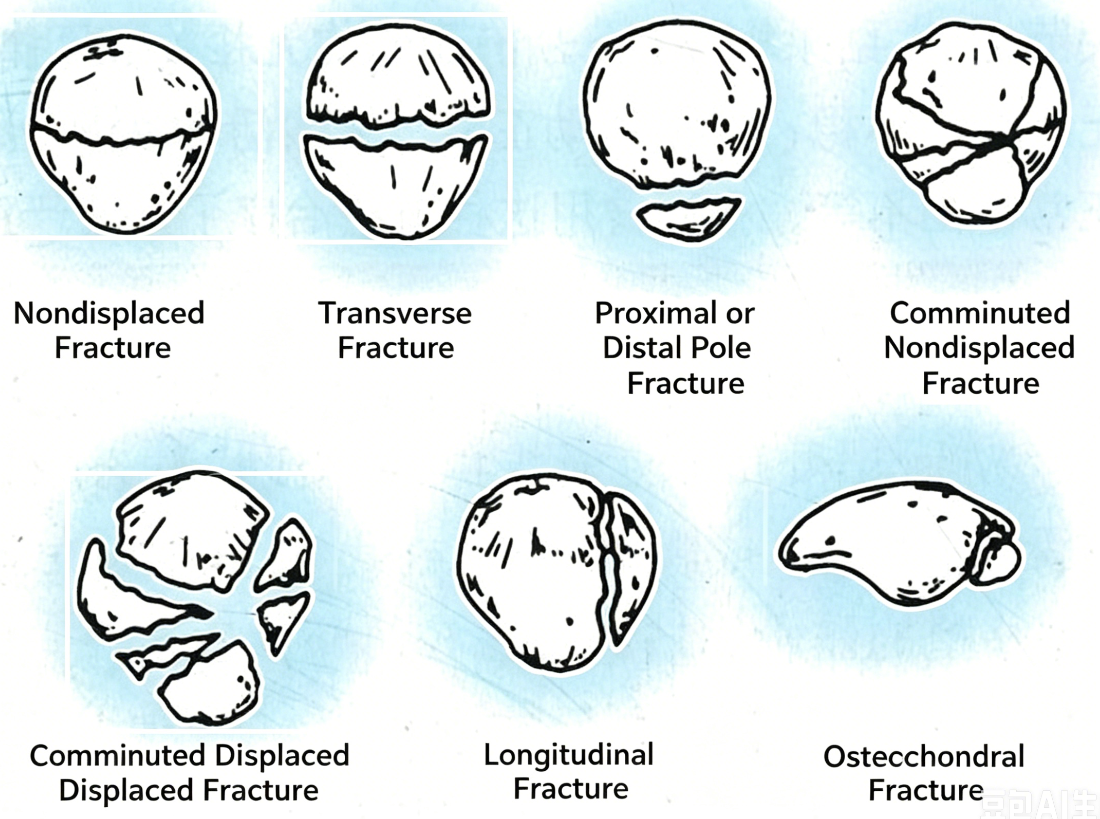
Patella fractures are generally classified according to fracture morphology and displacement patterns.Patellar fractures account for about 1% of all fractures, with transverse fractures being the most common, accounting for about 66% of patellar fractures.
1. Transverse Fracture
A horizontal fracture line divides the patella into superior and inferior fragments. This is the most common type and is often treated with tension band fixation.
2. Vertical Fracture
The fracture line runs longitudinally through the patella. Stable nondisplaced fractures may be treated conservatively.
3. Comminuted Fracture
Multiple fracture fragments are present, usually resulting from high-energy trauma. These fractures require strong and stable fixation.
4. Osteochondral Fracture
The fracture involves cartilage and subchondral bone, often associated with patellar dislocation.
5. Sleeve Fracture
Typically seen in pediatric patients, involving avulsion of cartilage and periosteum.
For comminuted and unstable fractures, orthopedic cable fixation offers superior circumferential compression and enhanced stabilization compared with traditional Kirschner wire fixation alone.
Advantages of Orthopedic Cable Systems
1. High Tensile Strength
Multi-strand orthopedic cables provide significantly higher fatigue resistance and tensile strength than monofilament wires.
2. Improved Compression
The orthopedic cable system converts tensile forces into compression forces across the fracture site, improving fracture stability and promoting healing.
3. Better Fatigue Resistance
Traditional stainless steel wires may break under repetitive knee motion. Orthopedic cables are designed to resist cyclic loading and reduce implant failure risk.
4. Enhanced Flexibility
The flexible structure allows easier contouring around bone anatomy while maintaining stable fixation.
5. Reduced Soft Tissue Irritation
Compared with bulky implants, low-profile orthopedic cable systems may reduce postoperative soft tissue irritation.
6. Suitable for Complex Fractures
Biomechanical Principle of Tension Band Fixation
During knee flexion, the anterior surface of the patella is subjected to tensile forces. A properly applied orthopedic cable tension band converts these tensile forces into compression forces at the articular surface.
This biomechanical conversion:
Enhances fracture stability
Promotes bone union
Allows early rehabilitation
Improves postoperative knee function
Compared with conventional wire fixation, an orthopedic cable system provides more uniform force distribution and improved long-term stability.
Surgical Techniques for Orthopedic Cable Fixation
Indications
Displaced transverse patella fractures
Comminuted fractures
Fractures with extensor mechanism disruption
Osteoporotic bone fractures
Revision fixation procedures
Surgical Procedure Overview
Step 1: Fracture Reduction
The fracture fragments are anatomically reduced under direct visualization.
Step 2: Temporary Fixation
Kirschner wires or reduction clamps may be used temporarily.
Step 3: Cable Placement
The orthopedic cable is passed circumferentially or in a tension band configuration.
Step 4: Tensioning
A dedicated cable tensioning instrument applies controlled compression.
Step 5: Locking and Fixation
The cable is secured using a crimp or locking mechanism.
Step 6: Final Assessment
Fluoroscopy confirms fracture reduction and implant positioning.
| Comparison Between Orthopedic Cable and Traditional Stainless Steel Wire |
|---|
| Feature | Orthopedic Cable System | Traditional Stainless Steel Wire |
| Tensile Strength | High | Moderate |
| Fatigue Resistance | Excellent | Lower |
| Compression Stability | Superior | Moderate |
| Flexibility | Excellent | Limited |
| Implant Failure Risk | Lower | Higher |
| Suitable for Comminuted Fractures | Yes | Limited |
Materials Used in Orthopedic Cable Systems
Stainless Steel Orthopedic Cable
Titanium Orthopedic Cable
Clinical Benefits of Early Mobilization
Faster recovery of knee function
Reduced joint stiffness
Lower risk of muscle atrophy
Improved patient satisfaction
Earlier return to daily activities
Orthopedic Cable Applications Beyond Patella Fractures
Trochanteric fixation in hip arthroplasty
Periprosthetic fracture management
Cerclage fixation in long bone fractures
Spinal fixation procedures
Revision arthroplasty stabilization
Osteotomy fixation
Future Trends in Orthopedic Cable Technology
Improved titanium cable systems
Enhanced minimally invasive instrumentation
Better fatigue-resistant materials
Smart tensioning devices
Personalized implant solutions
Hybrid fixation systems

Conclusion
The orthopedic cable system has become an important innovation in orthopedic trauma fixation. Compared with traditional fixation wires, orthopedic cables provide superior biomechanical stability, improved fatigue resistance, and enhanced fracture compression.
For patella fractures and other complex orthopedic procedures, orthopedic cable fixation helps surgeons achieve stable fixation, support early mobilization, and improve clinical outcomes.
As modern orthopedic surgery continues to advance, orthopedic cable systems will remain an essential solution for trauma reconstruction and fracture management worldwide.