Femoral Neck Fracture Fixation Solution | FNS SystemFemoral Neck Fracture Fixation Solution: Dynamic Cross Nail System (FNS Technique)
Introduction: Challenges in Femoral Neck Fracture Treatment
Femoral neck fractures are among the most common hip fractures, particularly in elderly patients with osteoporosis.
These injuries often result from low-energy trauma such as falls, while in younger patients they are typically associated with high-energy impacts.
Due to the unique blood supply of the femoral head and the biomechanical demands of the hip joint, femoral neck fractures present significant challenges in achieving stable fixation and preventing complications such as nonunion or avascular necrosis.
In recent years, the Femoral Neck System (FNS)—a dynamic cross fixation system—has emerged as an advanced solution for internal fixation, offering improved biomechanical stability and minimally invasive advantages.
Mechanism of Injury and Fracture Characteristics
Low-Energy Injury (Elderly Patients)
Impacted or initially stable fractures
High risk of secondary displacement
Caused by reduced bone density and stress concentration
High-Energy Injury (Younger Patients)
Traffic accidents or falls from height
Displaced and unstable fractures
Higher risk of femoral head blood supply disruption
Fracture Classification and Clinical Assessment
Irish surgeon Abraham Colles first proposed a classification system for femoral neck fractures as early as 1818, and more than a dozen classifications can be found to date. According to the latest literature, the Garden classification and classification based on anatomical location are among the most commonly used in clinical practice.
Garden Classification(according to the degree of displacement)
| Fractal | Description | X Manifestation |
| I | Incomplete fracture or abduction-impact type | Posterolateral impaction of the femoral head |
| II | Complete fracture with no displacement | Complete fracture line but no displacement |
III
| Complete fracture with partial displacement | Femoral head abduction and rotation, change in trabecular bone direction |
| IV | Complete fracture and complete displacement | The femoral head has returned to a neutral position and its relationship with the acetabulum is normal. |
 |  |  |  |
| I | II | III | IV |
| Type I and Type II fractures are considered stable fractures because the fracture ends do not shift and the degree of fracture damage is relatively small. | Type III and IV fractures are unstable fractures due to significant displacement of the fracture ends and greater fracture damage. |
Pauwels Classification(based on the degree of fracture displacement)
Subcapital type, transcervical type, basal type. This classification method is widely used in clinical practice because it involves the blood supply of the femoral head artery and is closely related to prognosis. The closer the fracture line is to the femoral head, the greater the likelihood of developing femoral head necrosis later.
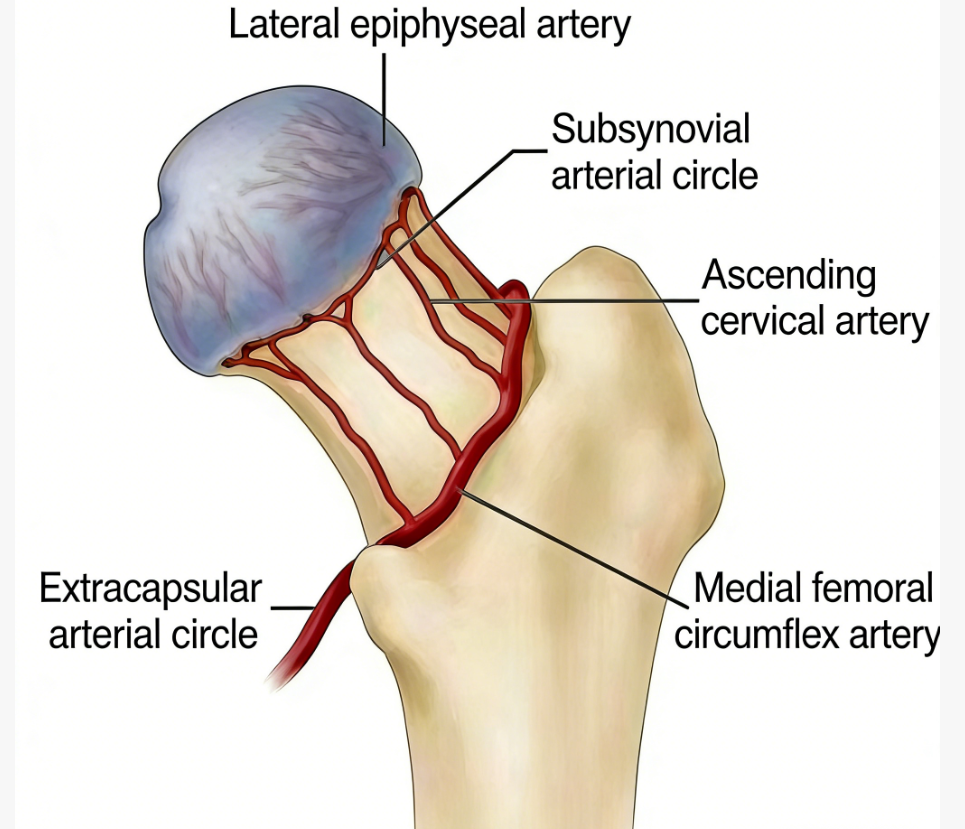 |  |  |  |
Subcapital
The fracture line is located at the head-neck junction; this type is rare and has a high probability of complicated femoral head necrosis. | Transcervical
Also known as the intermediate neck type, where the fracture line passes through the femoral neck, this type is relatively rare. | Basal
When the fracture line is close to the intertrochanteric line, this type of fracture is an extra-capsular fracture, similar to an intertrochanteric fracture. It has good blood supply and the best prognosis. |
Treatment Principles for Femoral Neck Fractures
Treatment plans are individualized based on factors such as the patient's age, fracture type, and overall condition:
Younger patients: Anatomical reduction and rigid internal fixation are the first-line treatments, preserving the joint itself.
Elderly patients: Internal fixation or joint replacement is chosen based on the fracture type and the patient's physical condition.
Conservative treatment has limited applicability and is only suitable for:
Garden type I impacted fractures
Patients who cannot tolerate surgery
Non-displaced fractures where the patient refuses surgery
Dynamic Cross Fixation: FNS System Overview
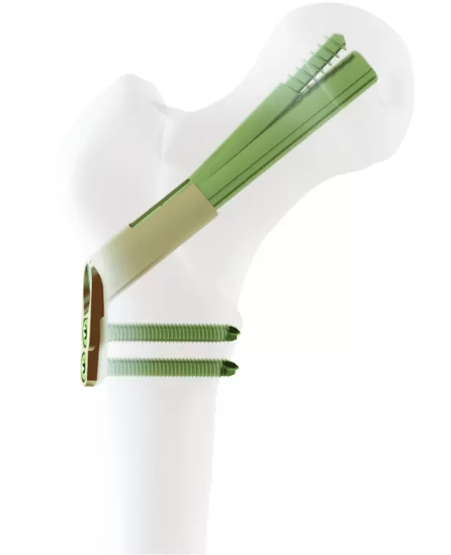
The Femoral Neck System (FNS) is a next-generation orthopedic implant designed for femoral neck fracture fixation.
It integrates angular stability with dynamic compression, enabling minimally invasive surgical procedures.
| Key Advantages of the FNS System |
 | 1. Superior Biomechanical Stability
Fixed-angle design (~130°)
High resistance to shear forces
Reduced fixation failure risk2. Dynamic Compression Mechanism Controlled sliding compression Promotes fracture healing Improves union rates 3. Anti-Rotation Stability Prevents femoral head rotation Enhances construct stability 4. Minimally Invasive Technique Single incision Reduced soft tissue damage Shorter surgical time 5. Optimized Implant Positioning Central placement in femoral neck Improved biomechanical alignment |
Surgical Technique Overview
Fracture reduction under imaging
Guidewire placement
Insertion of bolt and anti-rotation screw
Controlled compression fixation
Product Configuration
Locking plate
Central bolt
Anti-rotation screw
Instrumentation system
 | 
|  |
Type IV Angled Bone Plate Specifications: 2/3 hol | Type III Fixing pin Diameter: 10mm Length: 75-130mm (5mm intervals) | Type IV Fixing Screw Diameter: 6.4mm Length: 75-130mm (5mm intervals) |
Clinical Benefits
Conclusion
Femoral neck fractures require precise and stable fixation to ensure successful healing. The FNS dynamic cross fixation system offers a modern, reliable solution by combining biomechanical strength, controlled compression, and minimally invasive techniques.
With its advanced design, FNS enhances surgical outcomes and supports faster recovery, making it a preferred choice in modern orthopedic fracture management.